


Region Central Asia stretches from the Caspian Sea in the west to the border with estern part of China to the east; in the north the region borders with Russia; on the south by Iran, Afghanistan and China. The region occupied by five sovereign independent republics: Uzbekistan, Kazakhstan, Kyrgyzstan, Tajikistan and Turkmenistan.
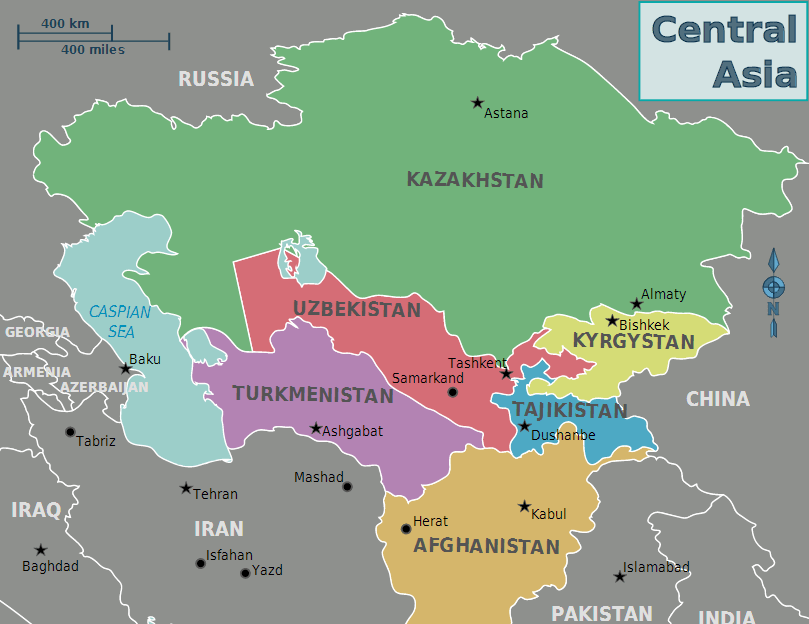
For the first time in Central Asia as a single region highlighted the German geographer and explorer, founder of the general geography Alexander von Humboldt in 1841. This term, he outlined all the internal parts of the Asian continent, stretching from the Caspian Sea to the west and a fairly uncertain border to the east. A more precise definition of Central Asia gave another German geographer Ferdinand Richthofen, the region is actually divided into two parts; in fact, Central Asia, on Richthofen, covers the area from Tibet in the south to the Altai Mountains in the north and from the Pamirs in the west to the east of Khingan. Aral-Caspian Depression Richthofen carried her to the transition zone.
This region is home to five major ethnic groups, which were formed back in the XVI century, -. The Uzbek, Kazakh, Tajik, Kyrgyz and Turkmen. All these groups speak a language related to the Turkic group of languages, with the exception of the Tajiks who speak Farsi. The dominant religion in the region among the population is Sunni Muslim. All five of these countries gained independence in 1991, each of them has chosen its own model of development, which is reflected in their constitutions.
Population of each republic has the title nation, but certain parts belong to other nationalities. Interethnic relations formed historically influenced by conditions such as the historical, demographic, migration, socio-economic, political.
After independence, all sovereign states are faced with threats, challenges not only political, economic, and social, but also ethnic plan, which demanded the revision of development strategy for the country and for establishing relations with the “new” neighbors.
In addition, often had unexpected obstacles, including many of their own internal problems. Some of them left over from the Soviet legacy, while others – from the ethnic and social structures of the emerging government. Some arose in connection with the peculiarities of intra-regional dynamics. Finally, developing nations have tried to integrate with neighboring countries to come out of years of isolation and enter into the world community. We decided to review the inter-ethnic problems that Central Asian countries are facing in the process of strengthening its sovereignty.
Inter-ethnic conflicts that arise in this region, by their nature characterized by the level of organization of political action, social movements in the form of mass riots, secessionist acts and even civil war, what is happening along the border, denoting ethnic differences.
As a rule, ethnic conflicts usually arise between the ethnic minority and the dominant ethnic majority, which controls the power and resources of the state. In the event of conflict, minority begins to question the functionality of the state and political structures. If there is no mechanism to regulate relations between the conflicting parties, then violence can progress.
Immediately after independence in many former Soviet republics, there was an upsurge of ethnic identity, which was accompanied by a wave of hostility towards russian-speaking population. This caused a massive outflow of Russian from former Soviet republics in the Russian Federation, in their historic homeland. Emergency migration also affected other ethnic groups, among them – germans, jews, poles, who began to move to other places.
We set out to see how you stack up inter-ethnic relations in each country of the region.
Uzbekistan – a multinational country. Historically, population in the territory it, within the boundaries of the modern republic was a multi-ethnic in its composition. Decisive factor for the stability of society in Uzbekistan has always been agreement on inter-ethnic relations.
Policy c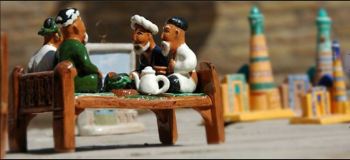 onsolidation and tolerance have become the main principles of ethnic policy of the Republic of Uzbekistan, that proves legal basis. According to the Constitution all citizens have equal rights and freedoms and are equal before the law without distinction of sex, race, nationality, language, religion, social origin, beliefs or individual or social status. The same policy can also be seen in other legislative acts of the country; the law on state language of citizenship and other documents states: All citizens of Uzbekistan have equal rights regardless of nationality, the State guarantees protection of rights and interests of people of all nationalities, prohibited discrimination against people of any nationality, as well as actions aimed at undermining the unity of nationalities.
Government is opposed to national chauvinism and nationalism; every nation has right of free use and development of their language and culture, has the right to maintain their own beliefs, traditions, rites and customs.
In the years of in
dependence have been established republican ethnic center and 130 national-cultural centers, including kazakh, jewish, armenian et al., opened schools, classes and nursery schools to training and education of children in the languages compactly living in various regions.
Stability of the socio-political situation in the country has been challenged in the days of conflict in the Fergana Valley in 1989, which occurred in the city of Fergana between 3 and 12 June 1989. However, June events preceded May clashes in Kuvasay that, apparently pushed the June performances. For the Fergana events followed some sporadic unrest in other regions of the country, took place until March 1990, when began the flight of most of the Meskhetian Turks from Uzbekistan.
Subsequently Fergana events, according to the more recent media reports, merged in people’s views into a continuous series of threats to the Turks by the Uzbeks. In fact, the events took place in a chaotic manner, Uzbeks accused the Meskhetian Turks in the attacks, robberies, in turn, the Turks put forward such accusations against Uzbeks.
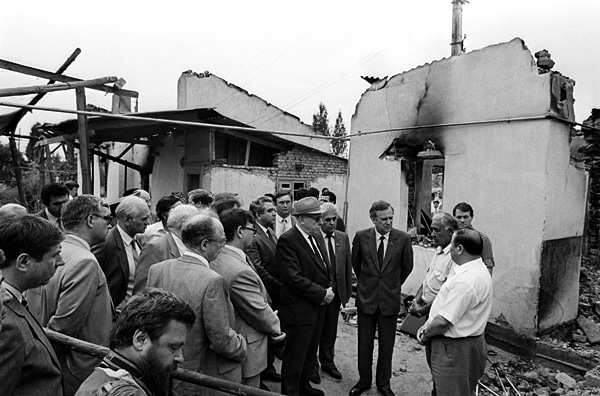
Events in Ferghana region held in three stages. The first stage – the collision between turks and, relatively speaking, the “indigenous” population of Kuvasay in the second half of May. The second stage – unrest in the form of attacks against Turks in Fergana, Margilan and neighboring localities. The third stage – the riots in Kokand city and neighboring areas. Within 10 days, according to the commission of the UzSSR, 103 people were killed during the events of June, of which 52 Meskhetian Turk, 36 Uzbeks and injuries received 1,011, 137 wounded military and 110 police officers. Burned and looted 757 houses, 27 state facilities, 275 units of vehicles. .
Data from other sources, mainly confirm given facts. Thus, according to B.B.Dziova, Deputy Chief of the Criminal Investigation Department of the USSR, the end of July it was revealed 106 victims according to the General Prosecutor’s Office of the USSR, the end of 1990 there were about 112 fatalities, including 51 Turks. By the end of July, an investigative team has identified more than 2 thousand. People involved in the commission of offenses, of which about 600 were “activists”. By the beginning of October 1989, 225 people were arrested, 41 of them – for deliberate murder. By December, initiated 238 criminal cases. By the end of 1990, 364 people, administrative arrests got 408 people were prosecuted.
Leaders of Uzbekistan promptly taken swift action to prevent scaling of the tragic events. This is to prevent spread of conflict to other parts of Uzbekistan, which demonstrated importance of respecting and preserving the inviolability of the historical traditions of friendship and good-neighborly relations in multi-ethnic population.
Ethnopolitics of Uzbekistan at present stage differs deeply thought-out concept under the slogan “Turkestan – our common home”, initiated by the head of the republic I. A. Karimov. For example, in the education system training is conducted in 7 languages, numerous publications are presented in 12 languages, there are more than 130 cultural centers, covering 27 nationalities, representing the largest ethnic groups, numbering hundreds of thousands of people.
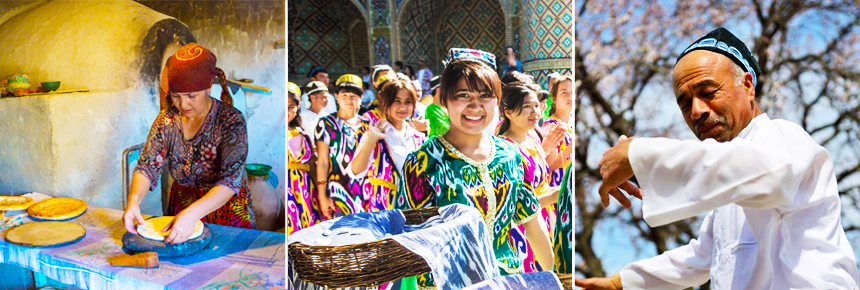 http://www.advantour.com/uzbekistan/people.htm
Thus, the ethnic policy of the Republic of Uzbekistan has sufficient historical and demographic, institutional, cultural basis for its further development and improvement in the conditions of democratization, modernization and renewal of the rule of law and civil society. Given facts lead to the conclusion that Uzbekistan is a country of ethnic and religious tolerance.
In Kazakhstan, a radical change in the whole social system that have taken place since 1991, also called the urgent need to find its own model of national policy, historic preservation, strengthening tolerance and friendship between ethnic groups, ethnic and socio-cultural groups.
The new model is formed taking into account several factors. Firstly, it was taken into account the positive and negative historical experience of regulation of the sphere of interethnic relations in Kazakhstan and in the world. Secondly, the model should be geared to the development of original and solidarity of ethnic groups in the new historical conditions. Thirdly, the system of interethnic relations should be implemented values of democracy and civil society.
Fourth, the decisive role in the inter-ethnic relations should have principles of tolerance and solidarity is not at the expense of ethnic prejudice, and by achieving social consensus.
However, in Kazakhstan, the previous trend of politicization of ethnicity. This was evidenced by the debate over published in autumn 2009 and presented for public discussion draft Doctrine of National Unity (DNU). In the autumn of 2009 and in January 2010 the supporters of ethnic approach to the understanding of the nation nominated alternative national policy concept. Taking into account, proposals submitted during the discussion of the project in April 2010, it was finally approved the text of the Doctrine of national unity of Kazakhstan. It argued that the development of ethnic groups and the formation of a multi-ethnic nation state, Kazakhstan seeks to build a well thought-out and effective policy for all citizens of the country as a part of the nation. The priority put forward following the basic principle according to which the concept of “nation” – a political community on the basis of nationality, while the concept of “ethnicity” – is a community on the basis of a greater or lesser degree of real or imagined common origin.
The adoption of the Doctrine of National Unity, content of which reflects a certain compromise in the understanding of the national policy, it contributed to the stabilization of inter-ethnic relations in society. However risks of extremism burst on an ethnic basis, as in any multi-ethnic country in the world.
Kazakhstan is home to more than 140 nationalities. Ethnic groups living in Kazakhstan presented in an organization such as Kazakhstan Assembly of Nations (KAN) and the consultative structures of the President of the Republic of Kazakhstan. The main objective of KAN – implementation of ethnic policy of the government, to ensure social and political stability in the country and improving efficiency of cooperation between state structures and civil society institutions in the sphere of interethnic relations.
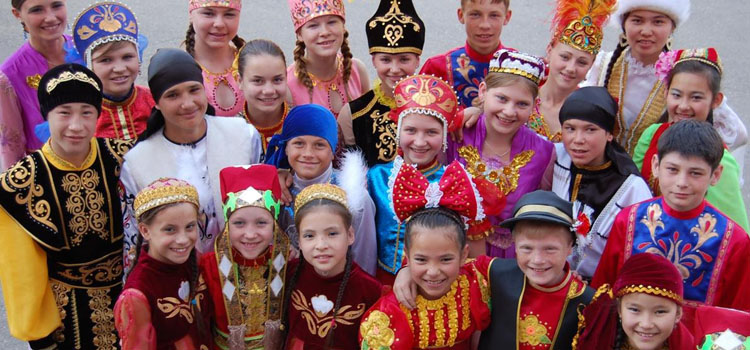
Note that 9 members of different ethnic groups of the Assembly, elected at the congress of the organization, presented as deputies in the lower house of parliament, in Majlis. This demonstrates the prevention of monopolization of the parliament of one ethnic group and ensures the opportunity to represent the interests of various ethnic groups in Kazakhstan.
In Kazakhstan, there was no serious mass interethnic conflicts of kazakh ethnic with representatives of other ethnic groups, especially with such a large diaspora, as a russian, and this proves the low level of nationalist ideas in Kazakhstan unlike neighboring Central Asian nations. This level of the kazakh people of tolerance is due to the historically lengthy stay in a multi-religious and multi-ethnic country, as well as a large percentage of kazakhs, who own a second language apart from their mother tongue, including a large percentage of ethnic kazakhs who do not speak the native language.
Nevertheless, it should be noted that in Kazakhstan after 1991. conflicts in almost all cases occurred between representatives of the titular nation and the representatives of the caucasian peoples.
However, an abundance of small inter-ethnic conflict since 1991. It explained not aggressiveness of the razakh people, but rather to the new political realities and domestic disputes. Sometimes it happens inter-ethnic clashes.
- So, in 1989, it recorded in new Uzgen conflict between kazakhs and chechens and lezgins; in 1992 – a collision between kazakhs and chechens in Ust-Kamenogorsk;
- August 20, 2006 there have been anti-caucasian statements kazakh population in the Caspian Sea city of Aktau;
- In october 2006, there was ethnic conflict on the deposit “Tengiz” – Mass arrests of Turkish and Kazakh workers Zhylyoi district of Atyrau region of Kazakhstan;
- In 2006, the kazakh-uighur conflict in Chilik; in november 2006, there were clashes kazakhs and uighurs in the village Shelek Almaty region;
- In march 2007 there was a kazakh-chechen conflict in Almaty region;
- In october-november 2007, there have been anti-kurdish statements Mayatas in the village, located in Tolebi district of south Kazakhstan region;
- In february 2015, the village Bostandyk south Kazakhstan region have been massacres of the local tajik population;
- In 2016 ethnic clashes occurred between kazakhs and turks.
State policy in the sphere of inter-ethnic positively assessed the majority of the population of Kazakhstan. It is important to emphasize that state policy in the sphere of interethnic relations “positive” estimate for the most part representatives of the titular nation – the kazakhs, while almost one-fifth of the respondents of russian nationality, who participated in survey, found it difficult to give any assessment carried out by state policy in this sphere.
Despite conflicts that arise from time to time, the government of the republic has managed to unite into a single whole contradictory trends of modern life. It has become a solid foundation for the sustainable development of the Republic of Kazakhstan.
In Tajikistan, for centuries representatives of many ethnic groups lived and worked peacefully, so national relations acquired a stable form, which contributed to the stable development of society.
The Constitution of the Republic of Tajikistan is prohibited from discriminating on grounds of race, nationality and ethnic origin. All are equal before the law and the courts. State guarantees the rights and freedoms of every person regardless of nationality, race, sex, language, religion, political beliefs, education, social status or wealth. All nations and peoples residing on the territory of the Republic of Tajikistan shall have the right to use their mother tongue.
Tajikistan has ratified a number of international acts relating to national minorities, among them – International Convention on the Elimination of All Forms of Racial Discrimination, the Convention on the Rights of people belonging to national minorities. According to the requirements of Constitution, they are considered an integral part of the legal system in Tajikistan and in case of any inconsistency the provisions of the laws of the republic to these acts than norms of international instruments accepted as a basis.
Tajikistan is home to 120 nations and nationalities, including Tajiks make up, according to the 2000 census, at 79.9%. Compared with the results of the 1989 census, the proportion of Tajiks grew by 17.6% – the highest figure in the rate of growth of the share of the titular nation among all the CIS countries and the Baltic States.
According to the 2010 census, the country’s tajiks account to 6373.8 thousand people, or 83.4%, uzbeks – 926.3 thousand, or 12.2%, kyrgyz – 60.7 thousand, or 0.8%, russian -. 34.8 thousand, or 0.5%, turkmen -. 15.1 thousand, or 0.2%.
Ethnic conflicts in Tajikistan took place in the 1990s. So, in 1989 there were clashes between the Tajik population of Isfara region of Tajikistan and the Kyrgyz population of Batken region of Kyrgyzstan, which was based on a conflict over land distribution. Fruitless attempts to settle the conflict, in which demands were made on the transfer of land to Tajikistan, continued until 1991, threatening to escalate into open conflict between the two former Soviet republics.
In 1989 there was a conflict over grazing distribution between Tajiks and Turkic Barlas in Ganchin region of Tajikistan, to liquidation of the USSR Interior Ministry troops that have been used.
In February 1990 Dushanbe rumors on the allocation of apartments to Armenian refugees. February 12, 1990, these rumors have caused riots and massacres that affected the Russian-speaking population. In the evening on February 13 in Dushanbe were enrolled tanks and army units that have managed to stop the riots.
July 31, 1991 was quite a large-scale clash of large groups of arabs and local tajiks in the village Kobadian, as well as between the tajiks – immigrants from Karategin. Newspapers mentioned that the conflict supposedly occurred on domestic violence in Kobadiana billiard hall, in fact, the clash was quite clearly seen economic causes of land shortage and a pronounced ideological coloration. In addition, there was civil war from may 1992 to1997 juny when ethnic groups from the Garm and Gorno-Badakhshan regions of Tajikistan, which were mainly Islamic-oriented groups following Vahabi ideology, rose up against the government of President Rahmon Nabiyev, which was dominated by people from the Khujand and Kulyab regions. It later began 5 years of bloody civil war, which took 100000 lives away. It means that even, tajiks ethnically divided to many groups, which brought later to civil war.
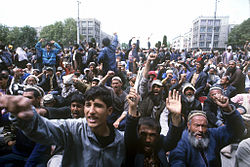 Rally at Shakhidon Square, Dushanbe in 1992
It can be argued that, whatever the subjective purpose of rioters in Tajikistan, the event gained a dynamic scope due to the fact that system is in a deep crisis, which was accompanied by the collapse of the USSR, the impoverishment of the population lack of irrigated land, as most of the area of the country is occupied by mountains arrays slightest inter-ethnic conflict was bound to lead to an explosion of discontent and riots. Such social conflicts broke out in various forms in the country, and later, indicating the social tension of the civil war began.
For Kyrgyz Republic the declaration of independence in 1991, has become a new stage in the development of national statehood. The unifying core for Kyrgyzstan multinational people became Kyrgyz ethnic group, constituting the majority of the population and gave the historical name of the country.
Constitution of Kyrgyz Republic states that all people are equal before the law and the courts. No one shall be subjected to any form of discrimination, violation of rights and freedoms regardless of their origin, sex, race, nationality, language, religion, political or religious beliefs or any other considerations or circumstances of a personal or public nature.
The country has ratified 7 of 9 universal international human rights treaties in the United Nations, including the International Covenant on Civil and Political Rights; International Covenant on Economic, Social and Cultural Rights; International Convention on the Elimination of All Forms of Racial Discrimination; The Convention against torture and other cruel, inhuman or degrading treatment or punishment; Convention for the Protection of the Rights of All Migrant Workers and Members of Their Families; Convention on the Elimination of All Forms of Discrimination Against Women; Convention on the Rights of the Child.
In 2011, Kyrgyzstan acceded to the UN Convention on the Rights of Peoples with Disabilities, which is under domestic procedures for ratification.
State policy in the sphere of inter-ethnic relations in the years of independence of the Kyrgyz Republic has passed three stages of development.
The first stage – after independence, it was characterized by an increase in the level of national consciousness of people, actualization of the ideology of nation-building and revival of kyrgyz statehood.
The second phase began in the mid 90s, when the slogan was nominated “Kyrgyzstan – our common home”. In 1994, the Assembly of people of Kyrgyzstan was established (APK), which constituted the basis of the cultural centers of ethnic communities. APK played a positive role as a consultative body and the most mass organization representing interests of ethnic communities. During this period, there have been attempts to regulate this sector at the legislative level.
The third phase, which began after 2005, characterized by a deterioration of the situation not only in the sphere of interethnic relations but also increased social conflicts in society, the manifestation of regionalism. It became obvious that the years of independence, not all citizens of different nationalities to realize themselves as part of the Kyrgyz Republic.
It should be noted that the provision of human rights and freedoms in Kyrgyzstan has become the main goal of reforms carried out in the community to improve the situation of citizens through the creation of decent living conditions, the guarantee of freedom and inviolability of individuals, as well as social protection.
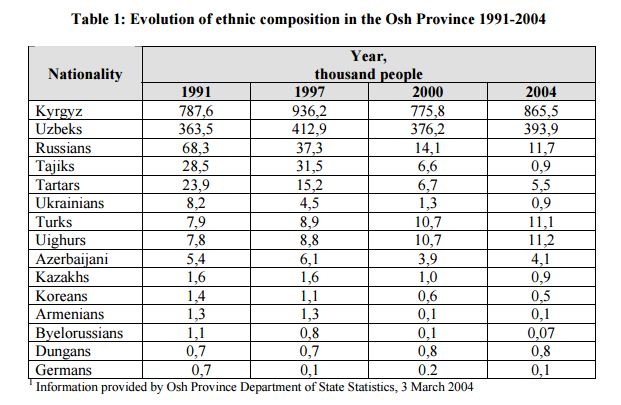
According to the population and housing census of the Kyrgyz Republic 2009. Country has more than 100 ethnic groups. According to the NPH, by the end of 2012. representatives of various ethnic communities made up 27.8% of the population, or 1,545,000 people. It can be concluded that Kyrgyzstan is a multiethnic state.
Among the population 72.6% are kyrgyz. They live throughout the country and prevail in most rural areas. In second place are uzbeks in number, who make up 14.5% of population is concentrated in the south-west of the country in border areas with Uzbekistan. Russian make up 6.4%, mainly concentrated in the cities and villages in the north of the country. Germans make up more than 6% of the total population of the republic .In structure of the population also includes dungan, tajiks, turks, kazakhs, tatars, azerbaijanis, koreans, ukrainians.
On the inter-ethnic relations situation influenced not only the geopolitical and psychological consequences of the Soviet Union collapse, but also the socio-economic difficulties of the transition period, including unemployment (especially in the regions possessing surplus manpower), the unsettled border, land, water and other issues with neighboring countries, the existence of territorial disputes.
Inter-ethnic relations in Kyrgyzstan were characterized by instability and were clearly conflicted character, which passed into the open pogroms in 1990 and 2010 Strengthening role of titular nation in all fields in 1990 – 2010. life occurred an accelerated pace. Especially sharply changed the national composition of the population in which proportion of ethnic kyrgyz increased from 40% in 1960. to 70 in 2009, and in the capital, Bishkek, from 6 to 58%.
A high level of social inequality in society and abrupt regional differentiation, politicization of interethnic relations against the backdrop of unemployment, lower levels of education, the presence of youth groups came under influence of radical religious movements and criminal groups intensified conflict potential of society. June 4, 1990 in city Osh began mass pogroms, arson and killing of Uzbeks. Riots swept Uzgen and rural areas, where majority of population is kyrgyz.
The most savage nature took clashes in g.Uzgene – the regional center, which was also the place uzbek communities. On the morning of 5 June there were mass brawl between kyrgyz and uzbeks, with the odds were on the side of the latter. In just a few hours hundreds of kyrgyz were beaten by representatives of the Kyrgyz community began to leave the city. Nevertheless, by noon, the city began to arrive organized armed groups of kyrgyz nearby villages. They have become the organizers and participants of numerous pogroms, arson, looting and murder. Only the appearance of military units stopped the riots, which could be catastrophic. It is believed that these events of 2010 created a motivation for the massacre of ethnic uzbeks.
According to the Ministry of Internal Affairs of the Kyrgyz SSR and USSR Interior Ministry, during mass riots in 1990 killed 305 people, injured 1371 people, including 1071 people were hospitalized, burned 573 homes, including 74 public institutions, 89 automobiles, committed 426 robberies. The seriousness of the situation of inter-ethnic relations are not recognized by public authorities, they underestimated economic and political conditions that give rise to tensions in interethnic relations.
Thus, the Republic of Kyrgyzstan has become a kind of center of ethnic conflicts of Central Asia primarily because of social inequality its peoples.
In Republic of Turkmenistan, since independence, ethnic groups began to feel in an unsafe situation, as clearly delineated the position of some leaders and their desire for the restoration of turkmen nation and strengthen the identity of ethnic turkmens. Unlike the tajik and kyrgyz republics, in this country, discrimination against ethnic minorities proceeded indirectly. For example, a trend has emerged that exalts the culture of the turkmen nation, and, conversely, underestimated the status of the cultures of other ethnic minorities. All this has led to increased migration of ethnic minorities in other countries, an increase in representatives of the titular nation in relation to other ethnic groups in the country.
Coming to power of Saparmurat Niyazov was marked by a sharp decline in the quality and status of the education and health of workers. In these areas marked by the migration of scientists and academics to foreign countries and at the same time the failure of the planned economy was recorded. Moreover, the president began the exaltation of the individual as the father of the nation.
UN human rights report for 2008 pointed out that even a change in the country’s leadership has not brought any significant improvement in human rights and civil liberties. Since gaining independence, the ethnic minorities in Turkmenistan have come under pressure, feel heavy burden of discrimination and exclusion. Robert Arsenault, president of the International League for Human Rights (ILHR) from New York, said that government only provides preferential treatment to open a favorable climate only ethnic turkmen.
The first standard of President Saparmurat Niyazov, has defined the newly created country of Turkmenistan as the famous home of ethnic Turkmen – indicates Erika Dailey, director of the Turkmenistan Project of the Open Society Institute; in this conceptualization is no place for non-turkmen in Turkmenistan. Thus, the state is trying to “shape turkmen” from its non-turkmen population.
Meanwhile, Turkmenistan’s constitution provides for equal rights and freedoms for all, regardless of nationality, origin, language or gender. However, promotion of ethnic turkmen from the state limits the opportunities for other ethnic groups living in this country.
In Article 177 of the Criminal code of the Republic of Turkmenistan stated; “Deliberate acts aimed at inciting social, national, ethnic, racial or religious enmity or discord, humiliation of national dignity, as well as propaganda of exclusiveness or the inferiority of citizens according to their attitude towards religion, social, national, ethnic or racial origin, punishable by a fine the amount of twenty to forty times the average monthly wage or imprisonment for up to three years. ” Thus, the formal state law for the protection of ethnic minorities adopted and enforceable.
In the last decade of XX century. turkmens share continued to increase against the background of the outflow of the russian-speaking population. Since 1989, the number of turkmen in Turkmenistan doubled – from 2.5 to 4.9 million people, while the number of russian – dropped by half.
In 1995, the Turkmens were 77% of the total population, and russian – 6,7%. february 18, 2001 Saparmurat Niyazov announced in the report before the National Council: “Turkmenistan is represented by more than 40 nations. We live with them in peace and harmony. 3% of the population – uzbeks and 2% – russian. Aboriginal nation – turkmen – up 91%. “The given Niyazov data are questioned by many experts. Thus, according to the MFA of the Russian Federation, of the 5.2 million population of Turkmenistan russian were 3.5% (about 180 thousand. pers.).
It is necessary to point out that major inter-ethnic conflict in Turkmenistan is not observed. According to experts, this is due to the following reasons:
• Share of the titular nation is so great that not even contenders in its place;
• Economic status of Turkmenistan than other Central Asian countries is in a satisfactory condition;
• Efficient resolution of inter-ethnic relations – a consequence of the consent of the other ethnic groups.
We consider it important to sign out the unusual characteristic of the turkmens (unlike kazakh and karakalpak): they have a very strong tribalism, which in turn requires promotion of the career ladder, depending on the tribe. From this, we can conclude that state of ethnic minorities in the Republic of Turkmenistan is evaluated as unfavorable. This is evidenced by a sharp decline of other nationalities in the state administration and other areas. According to European experts on human rights, Turkmenistan has a legal framework that regulates inter-ethnic relations and protects rights of ethnic minorities, but actual legal documents that protect the rights of ethnic minorities, are not working, as evidenced by indirect humiliation of ethnic groups.
Our study of inter-ethnic relations in Central Asia, allows you to make following conclusions. Between ethnic groups living in the region, serious contradictions persist, that will put them in a position of confrontation. Safety differs insufficient stability. Reasons for this are the following factors:
• fuzzy demarcation of borders of Central Asia;
• failure of the idea of integration of Central Asian countries on the basis of an economic union;
• complicated conditions of social existence of the region’s population (ecological crisis, low wages);
• developing of factors such as regionalism, tribalism, tribal affiliation.
Nature of ethnic conflicts in Central Asia is related to inter-state relations, therefore increasing likelihood of proliferation of ethnic conflicts in the interstate. Solution ethnic conflicts requires close attention of leaders of Central Asian states, whether they are of good faith, taking into account interests of each other, ready for any compromise in solving problems, openness and willingness to cooperate.
Bibliography:
V.1. Annan Kofi Speech. Globalization and the Nation State, 1998.
V.2. Baidarov Erkin. Interethnic and Interconfessional Relations in the Republic of Uzbekistan: Problems and Contradictions. – Almata, 2016.
V.3. Baker James A. Central Asia Confronting. Independence. Institute for Public Policy of Rice University. 1996.
V.4. Bauman Z. Globalization. The consequences for the individual and society. – Moscow: Ed. from English 2004.
V.5. Central Asia. Encyclopedia Britannica.
V.6. CIA — the World Factbook.
V.7. Ernest Gellner. The Theory of Nationalism. – Cambridge: University Press, 1998.
V.8. Fukuyama Francis. The End of History and the Last Man. – Published at free press, 1992.
V.9. Geertz C. The Interpretation of Cultures. – New York: Free Press, 1973.
V.10. Giddens Anthony. The Consequences of Modernity. – Cambridge, Polity, 1990.
V.11. Held David and McGrew Anthony. The global transformations reader. – Polity Press, 2000.
V.12. History of civilizations of Central Asia Part 1// Religions in the Central Asia Environment. – Published at UNESCO, Paris, 2000.
V.11. Huntington Samuel P. The Clash of Civilizations? Foreign Affairs, 1993.
V.12. J. Nye, S. Cohan. Transnational Relations and World Politics // Theory of International Relations: Readings / Comp, scientific. ed. and comments, P.A. Sigankov. – M., 2002.
V.13. Kaldor Mary. Nationalism and globalization.// Nations and Nationalism. 2004, 10.1‐2.
V.14. Kelly P. Multiculturalism Reconsidered. – Oxford, 2002.
Keunwon Song. Has Globalization Exacerbated Ethnic Conflicts? – Seoul. Published at Middle East Technical University, 2013.
V.15. Lobera Josep R. Recent theories of Nationalizm. – Barcelona Institut de Ciències Polítiques i Socials, 1999.
V.16. Mandryk Jason. Tajikistan // Operation World: The Definitive Prayer Guide to Every Nation. — Intervarsity Press, 2010.
V.17. Nadir Devlet. Ethnicity and Power: Relations between the Central Asian States // http://sam.gov.tr/wp-content/uploads/2012/02/NadirDevlet.pdf
V.18. Oriental express Central Asia. About religion In Central Asia. http//www/orexca/com|religia/shtml
V.19. Oriental express Central Asia// Religions in Republic of Tajikistan // http://www.tajikistan.orexca.com/
V.20. Parekh B.C. Rethinking Multiculturalism: Cultural Diversity and Political Theory. – Cambridge, Mass.: Harvard University Press, 2000.
V.21. Robertson R. Globalization: Social Theory and Global Culture. – SAGE.1992.
V.22. Sawatsky Walter. Tajikistan // the Encyclopedia of Christianity / Erwin Fahlbusch, Geoffrey William Bromiley. — Wm. B. Eerdmans Publishing, Vol.5 том. 2008.
V.23. Shafir G. Immigrants and nationalists: ethnic conflict and accommodation in Catalonia, the Basque Country, Latvia and Estonia. – N.Y., 1995.
V.24. Turkmenistan.Freedomhouse.org. Retrieved 2016, 02, 14// “2008 Human Rights Report: Turkmenistan”. State.gov. Retrieved 2016, 02, 14.
V.25. Valadbigi Akbar and Ghobadi Shahab. Ups and Downs of Ethnic Identity in the Era of Globalization. Published: august 1, 2011 under CC BY-NC-SA.
V.26. Waster’s New World College dictionary fourth edition. – Canada: Wiley publishing 2000.

 Politics/Conflictology/International Relation